
gustavofreze/rust
Hardened, reproducible Rust base images: runtime, development, builder and cli. Non-root.
743
gustavofreze/rust repository overview
gustavofreze/rust
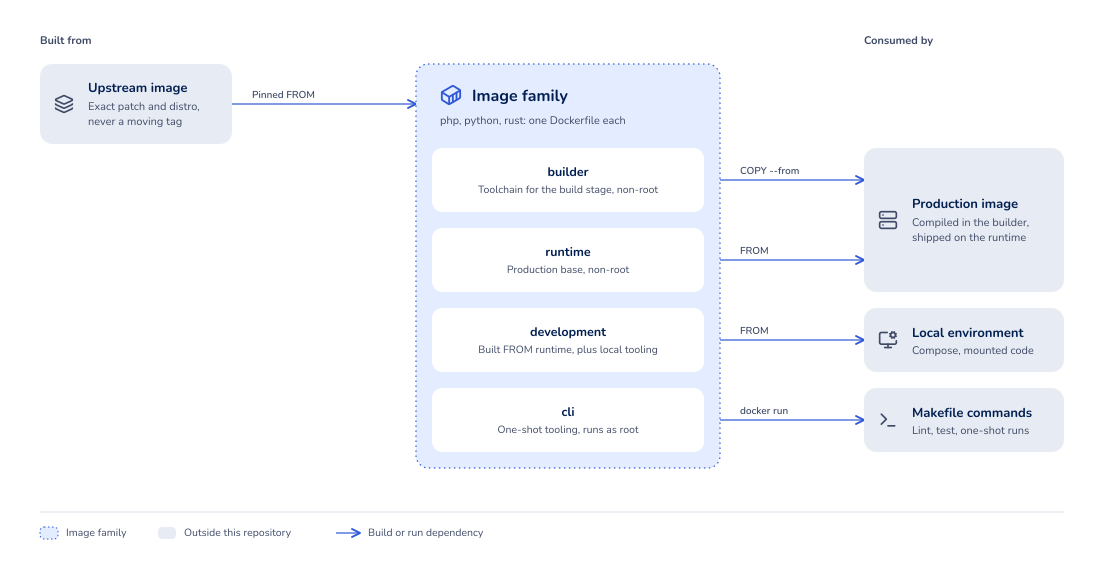
Hardened, reproducible Rust base images. One Dockerfile per upstream version ships four targets: the production
runtime for a static binary, its development variant, the builder toolchain for a project's production build,
and a cli tooling image a project Makefile invokes.
Quick reference
- Maintained by: Gustavo Freze
- Source: gustavofreze/docker-images
- File an issue: docker-images/issues
- Also published as:
ghcr.io/gustavofreze/rust - Architectures:
linux/amd64,linux/arm64 - Supply chain: every tag ships a build provenance attestation and an SBOM, and carries no accepted risk
- License: MIT
Supported tags
| Tag | Alias | Purpose |
|---|---|---|
1.100-runtime-1.0.1 | 1.100-runtime | Production base for a static binary. No toolchain, no shell kit. |
1.100-development-1.0.1 | 1.100-development | Local development and Dev Containers: runtime plus the toolchain. |
1.100-builder-1.0.1 | 1.100-builder | Cargo and the musl toolchain for the builder stage of an image. |
1.100-cli-1.0.1 | 1.100-cli | Makefile tooling: Cargo, Clippy, rustfmt, git, bash, curl. |
Every tag is <upstream-minor>-<target>-<version>. There is no bare tag and latest is forbidden.
- Versioned tag. Immutable and reproducible. It moves only when you bump it, so take it for anything that ships.
- Alias. Tracks the latest rebuild of its target, the monthly security rebuild included, and never crosses an
upstream minor:
1.100-runtimestays on 1.100. It moves only when the client re-pulls, which suitscliand local development.
All four are built from one multi-target
Dockerfile, pinned to
rust:1.100.0-alpine3.24 for the toolchain and to alpine:3.24.4 for the runtime.
Image variants
| Target | Runs as | On top of the base |
|---|---|---|
runtime | app (uid 1000) | Nothing. A pinned Alpine in a single layer, around 13 MB. |
development | app (uid 1000) | runtime plus rustc, Cargo, Clippy, rustfmt, rust-src, gcc, bash, git, curl. |
builder | app (uid 1000) | The upstream toolchain: rustc and Cargo targeting musl, gcc, musl-dev. |
cli | root | builder plus Clippy, rustfmt, bash, curl, git. |
runtimeis not built on the Rust image. A release binary targeting musl links statically, so it needs no interpreter, no standard library on disk, and no compiler runtime.developmentis builtFROM runtime. It runs on a developer machine and is never deployed.builderkeeps the whole toolchain on purpose. It is the stage a project compiles its binary in, and the multi-stage application build discards it.clistays root so it can write into a bind mount owned by the caller.- No target ships a
HEALTHCHECKor exposes a port. These are language bases, not services, so the application that inherits the runtime declares the health check for the process it actually runs.
What it provides
Every image provides, and no consuming Dockerfile re-declares:
- A non-root runtime. The
appuser (uid 1000), whose home is the/appworking directory it owns. - The Alpine certificate bundle at
/etc/ssl/certs/ca-certificates.crt, so a binary that verifies TLS against the system store works unchanged. A project that trusts a private authority adds theca-certificatespackage itself. - A current zlib, upgraded to what the Alpine index serves at build time instead of aging in place between base releases.
RUST_BACKTRACE=1inruntimeanddevelopment, so a panic prints its backtrace instead of a hint to set the variable.- No toolchain in production. The
runtimecarries no Cargo, no rustc, no linker, no git, no bash, and no curl, and the smoke suite asserts each absence. - Static binaries with no flag. A release build in the
builderlinks statically against musl, and the smoke suite proves it by running one in theruntime. - A writable
CARGO_HOMEat the upstream/usr/local/cargowherever the toolchain ships, so theappuser fetches crates into it with no extra configuration. - A Dev Container ready
development. It carriesrust-src, so an IDE resolves the standard library, and the packages a JetBrains backend needs inside the container:gcompat, the X11 rendering libraries,curl,unzip, andprocps.
How to use this image
As a base image
A project consumes the base in two thin files and adds only its own dependencies, code, and tuning:
# syntax=docker/dockerfile:1
FROM gustavofreze/rust:1.100-development-1.0.1
COPY ./ /app
# syntax=docker/dockerfile:1
FROM gustavofreze/rust:1.100-builder-1.0.1 AS builder
COPY Cargo.toml Cargo.lock ./
RUN cargo fetch --locked
COPY ./ ./
RUN cargo build --release --locked --offline

FROM gustavofreze/rust:1.100-runtime-1.0.1
COPY --from=builder --chown=app:app /app/target/release/your-application /app/your-application
CMD ["/app/your-application"]
cargo fetch reads only the manifest and the lock file, so the dependency download is its own layer and a code change
does not repeat it. A crate that links a C library needs that library's development package in the builder stage and
its shared object in the runtime stage, both added by the project.
As a Dev Container
The development target is the image a Dev Container runs, with the project mounted as its workspace:
{
    "image": "gustavofreze/rust:1.100-development-1.0.1",
    "remoteUser": "app"
}
As a tooling image
The cli image is invoked directly and never appears in a Dockerfile.
To lint the code, run:
docker run --rm -v "$(pwd)":/app gustavofreze/rust:1.100-cli-1.0.1 cargo clippy --all-targets -- -D warnings
To check the formatting, run:
docker run --rm -v "$(pwd)":/app gustavofreze/rust:1.100-cli-1.0.1 cargo fmt --check
The rules that hold across every family live in the usage contract.
Verification
No tag is published before it passes the full
gate, on a native linux/amd64 runner and a native
linux/arm64 one:
| Stage | Tool | What it checks |
|---|---|---|
| Lint | hadolint, ShellCheck | Every Dockerfile and every RUN body. |
| Scan | Trivy and Grype | Fixable HIGH and CRITICAL vulnerabilities. |
| Audit | Dockle | The CIS Docker Benchmark. |
| Efficiency | dive | Wasted layer space. |
| Smoke | throwaway containers | The runtime contract, in throwaway containers. |
The smoke suite asserts the non-root user, the pinned toolchain version, linters only where they belong, the absence of a toolchain in the production surface, and a release binary compiled in the builder running in the runtime.
This family carries no accepted risk, so it publishes no OpenVEX analysis and no scanner exemption of any kind. Every scan in the gate runs bare, and what it reports is what the images contain.
To scan a tag yourself, run:
trivy image gustavofreze/rust:1.100-runtime-1.0.1
License
Tag summary
Content type
Image
Digest
sha256:497b649ca…
Size
365.2 MB
Last updated
3 days ago
docker pull gustavofreze/rust:1.100-development